Food for the mountains and photos from the Tower of Babel
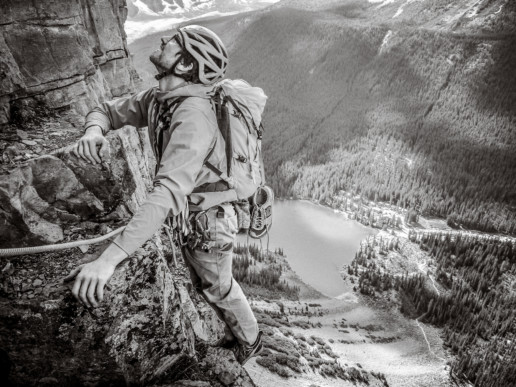
I wanted to put together a few of my favorite photos from the Tower of Babel because with so much media created it’s not hard to lose a lot in the shuffle of moving on to the next thing! This is a short post and by the time you’re reading it I’ll be on my way into the backcountry for another adventure in the mountains-this time the Bugaboos! Martin and I are going for a larger objective than the Tower of Babel-the Northeast Ridge of Bugaboo Spire-which is beautiful and quite a long day. It will surely test our ability to move efficiently and cover a lot of ground.
Today we are packing up and gathering food-laying plans and tactics for the coming days. It’s exciting to be returning to the Bugaboos (which I haven’t visited since Project365 in 2012) but it’s also a little nerve wracking because once you’re out there-you’re out there and it’s too late to pick up that one last item you left back at the trailer!
- My breakfasts: a few spoonfuls of my peanut butter-sunflower seed and hemp seeds concoction, along with bulletproof tea (coconut oil with tea) and some cheese.
- Snacks/Lunch: cheese and salami, Brazil nuts, jerky.
- Dinner: Boullion soup, coconut oil, greens, cheese and tuna fish.
- Glucagon, Clif bars, shot bloks and dark chocolate for emergencies/low BGs
I hope to be back out of the wilderness and reconnected by early next week with lots more photos and video to share. In the meantime, I hope some of these photos inspire you to get out and find some adventure of your own. There’s a lot out there and it belongs to us all.

Crowdfunding: a frank discussion
LivingVertical isn’t for everyone. It’s for YOU. That’s why I am asking you for the opportunity to make this mission, this message my full-time priority by pledging support for our work via our recently launched Patreon campaign. It’s loaded with exclusive rewards which you can see for yourself, including our first foray into print media-The AdventureRx Journal.
Over the past few years you’ve watched me attempt to juggle the disparate goals of supporting a family and creating revolutionary adventure media that can overthrow the limitations of type 1 diabetes.
I’ve decided to stop juggling.
I’ve committed to LivingVertical full time. That means sink or swim-a test that I’ve been able to protect LivingVertical from for years. I’ve worked many different jobs to support this effort myself and I don’t regret keeping it on life support in order to get back to this point of giving it my full time focus. Now, the question is ‘How long can I afford to maintain this commitment while supporting my family?’.
When I first began working to create empowering adventure films, blogs and photos in 2011 I had a sort of luxury of being free to live in the dirt. Literally. I took great pride in doing more with less. It felt rebellious to start taking a stand without asking for “permission” from corporate sponsors. Having basically no overhead made us hard to squash-like post apocalyptic cockroaches. I never anticipated success. When Project365 was completed there was too much momentum to just walk away from LivingVertical-but no pathway for sustaining a living from it either. I assumed that if LivingVertical was good enough some company would sweep me off my feet and give us the financial support required to ride off into the sunset creating inspiration and empowerment for the world at no cost.
I often have been told that “It would be great if (insert drug/device company name here) sponsored you! Seems like you would be a great fit. Have you ever looked into that?” I have had some great relationships with sponsors in the past-but we never rode off together into the sunset. Short term engagements left me searching for ways to attract the next short term engagements. My focus couldn’t be the work and the message. The message mattered to me and my audience-but it wasn’t what was supporting me financially.
The reason I am attempting to crowd-fund the backbone of our support is because I want to change that. I believe that my audience and the message come first. Having audience support is what allows that freedom to exist.
No one is entitled to having an audience, let alone support from that audience. The fact that you’re here with me means that I’ve been given a wonderful gift already. I have no intention of putting my work behind a wall and making it pay-to-play. I’m asking you for the opportunity to make the free, public work of LivingVertical bigger, better and more impactful.

You can call me diabetic
You can call me diabetic if that’s what works for you. I won’t call the language police to shut down communications. Silence doesn’t help those of us living with this condition and it doesn’t help the outside world deal more gracefully with admittedly difficult subject matter.
I’m not saying that words don’t matter. Words do matter-not because of an inherent value in the words themselves but because of the context. Words matter because of how we interact with them. Trying to protect ourselves from terms themselves is asking the wrong question. Leaning into the effort of influencing context and controlling the narrative is proactive. It’s something for which we can take responsibility. We can change what words mean through action. That starts with taking ownership in our own life. The point of this exercise is to change our perspective. The benefit to us is a better life, independent of the willfully ignorant.
Scrutinizing semantics shifts the focus outside of the things we control. Asking how we can break underlying ignorance seems closer to the mark. Person with diabetes, climber, diabetic, diabetic climber-are all accurate. None of those words makes me who I am. They don’t define me-I define them. Doing that work is something I own-it’s not something I’m willing to outsource. The heart of being successful with this disease involves questioning everything and being independent enough to formulate your own rules based on what works for you, not playing by rules handed down from internet authority figures or arcane medical tropes.
I’m aware that I’m asking you to freely reject my position as part of my platform. I’m no authority figure. I’m just one person. I’ll choose to define the value of diabetes for myself, thank you. That includes all the words and the nomenclature that comes with it. It’s my disease and I’ll paint it any color I want.
Yes I quit drinking coffee. Here's why...
I recently announced on Facebook my decision to quit drinking coffee. This declaration was met with some disbelief and horror given my erstwhile penchant for drinking coffee. I’m still a little bit surprised at how personally people take it when you announce that you’re choosing to do something differently with your diet. I promise, I didn’t quit coffee in order to disrupt social conventions and that there is a legitimate reason for my choice. That reason is a combination of two factors: type 1 diabetes and El Capitan in Yosemite.
I failed on El Capitan in 2012 during Project365 and I vowed to return, but conveniently avoided doing so for a number of reasons that all seemed legitimate at one time or another. No one wants to fail and it’s even less appealing when people are watching. It’s also a lot more difficult being marooned on a tiny island in a vertical sea of granite for days at a time when you know that your body could revolt against you at any point, potentially with dire consequences. It’s incredibly committing to feel medically vulnerable in a position that is so isolated.
Fear. It either becomes the reason to DO or to NOT DO.
Once I chose to let fear into the decision making process, I stopped making forward progress. Everything devolved into a circular holding pattern. It’s totally reasonable to be afraid of having a low blood sugar on the wall. It’s fine to be afraid of getting dehydrated and cramping up, or hauling too much extra or not enough extra. It’s not ok to let that fear paralyze you.
Fear is a useful ally if it’s not allowed to dominate the conversation. For that reason I am training. Preparing. Working out ways to mitigate situations that I am afraid of. That’s what the next several months will entail-and here is where the decision to quit coffee comes in. I have found that one of the biggest factors that hindered me on past bigwall climbs has been dehydration which leads to cramping. Dehydration has also gone hand in hand with my most erratic blood sugar swings-which is anecdotal, but it is a pattern that I’ve noticed.
It’s also worth noting that low carb diets definitely leave you more vulnerable to dehydration if you don’t take consistent and fairly aggressive action to mitigate the diuretic effects of carb restriction. This is definitely one of the downsides that significantly offsets the blood sugar stability and energy that I have enjoyed in the last year of following a ketogenic diet. There’s always a catch! It’s not a deal breaker for me-it’s a trade off. Coffee is part of what I’m choosing to sacrifice in order to be able to climb further and harder-and hopefully it will make it easier for me to stay adequately hydrated.
I will follow up on this in upcoming blogs because I am genuinely curious to see if this change will impact the way that I feel and my blood sugar as I am training. I have to say that so far I don’t miss the jittery nerves, anxiety and insulin resistance I used to experience every morning with my coffee.
1000 feet of climbing before lunch! (video)
Red Rock Nevada was a great stop on our journey-because where else can you knock off 1000 feet of climbing before lunch on just about any given day? This was a short stop for us-three days or so-but that was enough for me to start off fighting a low blood sugar on the first day of climbing and dialing in my insulin and diet to match my energy output. By day 3 I felt like I hit a great stride and this really has improved my confidence about what I can do, despite having to deal with diabetes.
Stay tuned for more videos coming up about my journey with diet and tips about adapting type 1 diabetes to being more active. Being empowered to push our limits is an incredible tool to take back our health and the more I can do to encourage and facilitate that, the better!
If you enjoyed this video make sure to subscribe to our YouTube channel as we keep on the move!
Ok. So here’s where I’d like to hear from you. Have you ever felt like some good has come from a challenging moment with your diabetes? Drop a comment and let’s chat!
Or if you’d rather discuss in private: [email protected]


How a low blood sugar forced me to face my fear
I had my best day ever just a short while ago and I owe it all to a low blood sugar. It all started a few days ago, after our type 1 meetup in Joshua Tree as I spent several days climbing with Rob in Las Vegas (you may remember him from Project365 and our many adventures together). He asked me, “Dude, do you want to link up a bunch of moderate routes over the next few days? I only have a couple days off, so we would have to get up early every day and just crush ourselves and see how much we can climb in 3 days.”
Ketogenic climbing | low carb athletes with T1D
I am considering doing a video series in the near future for low carb athletes with T1D about my dietary approach, trial and error and adapting the ketogenic diet to give greater blood glucose stability and athletic performance. I still feel like this is all in the “test phase” because the results I have had are not extensive. That said, I will be sharing developments as they occur in hopes of pushing the limits of what we are able to do with our diabetes.
Losing control, gaining influence
Somewhere between pride and despair lies acceptance. I could only hear the sound of wind whistling past my ears as I stepped delicately around the airy corner; about 1500 feet of nothingness separated me from the ground. The fact that I was actually able to stand on the sloping, sandy ledge beneath my feet seemed to defy what I’d come to learn about physics. ‘Here goes literally everything‘ I thought for the 1,336th time since starting to climb “Cowboy Ridge“ that morning. I shifted my weight forward to test the only viable handhold that would grant me access to the ledge above. I tried to weight the hold gradually because I didn’t want to ricochet off into the void if it popped. I pulled back a handful of sand as the rock disintegrated in my hand.
Climbing Cowboy Ridge in Zion National Park
I’ve spent a lot of time in Zion National Park over the last few years and it’s no secret that the climbing here is outside my comfort zone. Maybe that’s why I keep coming back-because there are “easy” climbs like Cowboy Ridge that have mocked me from afar. It’s a 5.7 filled with route-finding, loose rock and lots of elevation gain. It’s a long day and it’s far from civilized comforts should poor planning or blood sugar fluctuations interfere. It’s not the dark side of the moon, but it’s more involved than lowering down off a single pitch climb and ‘calling it a day’. Maybe this is part of getting back into the swing of things, but I’ve been more intimidated by this “loose end” than I’d like to admit, so I decided to tie it off ASAP.
How does the keto diet work on the road?
In the last few posts I’ve been focused on the challenges (read: chaos) of getting adapted to living in a tiny home (trailer). That process is far from complete and while we are waiting I thought I would touch on a question I’ve been getting from a few people regarding the keto diet that I am using to control my type 1 diabetes and improve my climbing. Having to manage blood sugar can complicate even the simplest tasks and I can honestly say that dealing with the stress of this move would be impossible for me to tolerate if I had to devote more of my focus to erratic blood sugar swings. I’ve written a lot about how the keto diet has worked for me (including failures and challenges) but in this post I want to focus on how living on the road has impacted my ability to eat a low-carb high-fat diet.
